


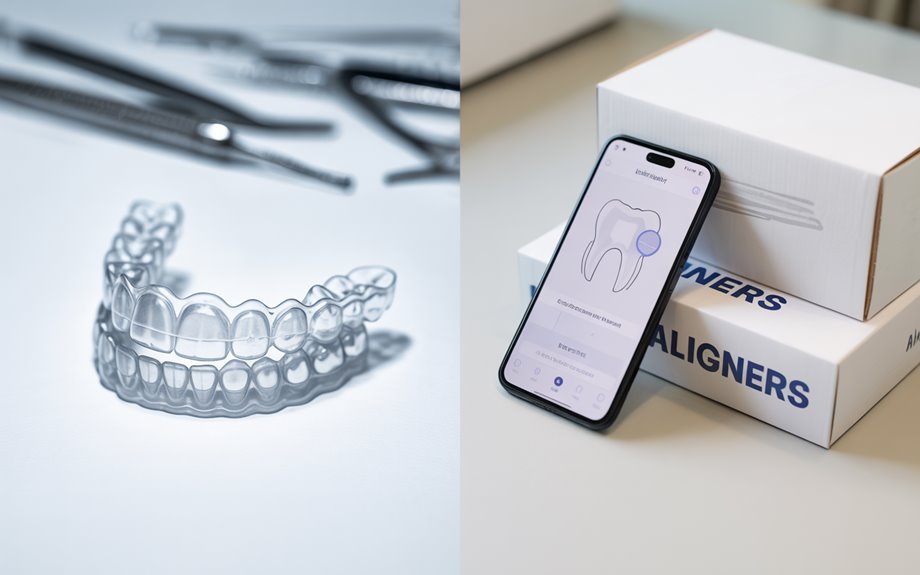
Invisalign offers thorough orthodontic care with in-person consultations, professional supervision, and advanced 3D scanning technology, costing $3,000-$8,000 but handling complex cases effectively over 12-24 months. Smile Direct Club provides remote treatment for mild to moderate issues at $1,895-$2,295 with limited professional oversight and 4-10 month duration. You’ll find Invisalign covered by most dental insurance plans while Smile Direct Club receives minimal coverage. Understanding these key differences will help you make the most informed decision for your specific orthodontic needs.
Treatment Process and Professional Supervision
When choosing between Invisalign and Smile Direct Club, the treatment process and level of professional supervision represent one of the most significant differentiating factors you’ll encounter.
The level of professional supervision differs dramatically between these two popular clear aligner treatment options.
📋 Invisalign Treatment Process
- In-person consultations with licensed orthodontists or dentists throughout treatment
- Digital impressions taken at dental offices using advanced 3D scanning technology
- Regular progress monitoring appointments every 6-8 weeks for adjustments
- Thorough orthodontic care includes bite analysis, jaw alignment assessment, and oral health evaluation
📱 Smile Direct Club Process
- Remote treatment model with limited in-person dentist guidance
- At-home impression kits or brief visits to SmileShop locations for scanning
- Virtual monitoring through smartphone photos and telehealth consultations
- Reduced hands-on professional oversight during active treatment phases
The fundamental difference lies in continuous professional supervision versus mainly self-managed care with remote check-ins. Modern dental practices utilize digital diagnostics and cutting-edge technology to ensure precise treatments and optimal patient outcomes throughout the alignment process.
Cost Comparison and Payment Options
When you’re choosing between Invisalign and Smile Direct Club, understanding the financial investment becomes vital since treatment costs can vary markedly between these two orthodontic options.
You’ll find that pricing structures differ substantially, with various insurance coverage possibilities and payment plan arrangements that can impact your overall out-of-pocket expenses throughout the treatment duration.
Your decision will likely depend on comparing the total treatment costs, evaluating your insurance benefits coverage, and selecting the most suitable payment flexibility option that aligns with your budget constraints and financial preferences.
For personalized guidance on choosing the right orthodontic treatment within your budget, consider consulting with dental professionals who can provide detailed cost breakdowns and help you explore all available payment options.
Treatment Pricing Breakdown
Two primary factors determine your orthodontic treatment investment: the complexity of your dental alignment needs and the provider you choose, with Invisalign typically ranging from $3,000 to $8,000 while Smile Direct Club offers treatments between $1,895 and $2,295.
💰 Clear Costs Breakdown
- Invisalign: $3,000-$8,000 depending on case complexity, treatment duration (12-24 months), and geographic location
- Smile Direct Club: $1,895-$2,295 for standard treatment options, with 4-6 month average duration
📋 What’s Included
- Invisalign: In-person consultations, regular orthodontist visits, refinement aligners, retainers
- Smile Direct Club: Remote monitoring, impression kit or 3D scan, aligners, basic retainer set
The significant price difference reflects varying service levels, with Invisalign providing thorough orthodontic supervision while Smile Direct Club offers streamlined, technology-driven treatment options.
Insurance Coverage Options
Understanding your insurance benefits can substantially reduce your orthodontic treatment costs, as many dental insurance plans now cover clear aligner therapy with varying coverage levels between traditional in-office care and direct-to-consumer options.
📋 Insurance Coverage Breakdown
Invisalign Coverage:
- Most dental benefits recognize Invisalign as orthodontic treatment
- Typical coverage ranges from $1,000-$2,500 annually
- Requires pre-authorization through participating orthodontists
- FSA/HSA eligible for remaining balances
Smile Direct Club Coverage:
- Limited insurance policies accept direct-to-consumer aligners
- Coverage typically ranges from $200-$500 maximum
- Often categorized as cosmetic rather than medical necessity
- May require additional documentation for reimbursement
You’ll need to verify your specific plan’s orthodontic benefits, annual maximums, and provider network requirements before beginning treatment with either option.
Payment Plan Flexibility
Beyond insurance benefits, flexible payment structures can make either treatment option more accessible to your budget, with both Invisalign and Smile Direct Club offering distinct financing approaches that cater to different financial preferences and circumstances.
💳 Invisalign Financial Options
- Monthly payment plans through CareCredit, typically ranging from $100-$200 per month
- Third-party financing with 0% APR promotional periods, usually 12-24 months
- In-house payment plans offered by individual orthodontist offices
💰 Smile Direct Club Affordable Solutions
- Single upfront payment of $1,895 with $250 discount incentive
- SmilePay monthly installments starting at $89 per month for 26 months
- No credit check required for their internal financing program
You’ll find Invisalign’s financing depends heavily on your orthodontist’s partnerships, while Smile Direct Club’s streamlined approach offers consistent payment terms regardless of location.
Complexity of Cases Each Can Handle
When you’re choosing between Invisalign and Smile Direct Club, you’ll need to understand that each treatment option handles different levels of orthodontic complexity, ranging from simple spacing issues to more challenging bite corrections.
Your specific dental situation will largely determine which service can effectively address your needs, as Smile Direct Club focuses primarily on mild to moderate cosmetic adjustments while Invisalign offers solutions for a broader spectrum of orthodontic cases.
The complexity of your alignment issues, crowding severity, and any underlying bite problems will ultimately guide you toward the most appropriate treatment path for achieving your desired results.
A thorough evaluation of your treatment options by a qualified dental professional can help determine which clear aligner system best suits your specific orthodontic needs and complexity level.
Mild Alignment Issues
While both Invisalign and Smile Direct Club specialize in treating mild to moderate orthodontic issues, the complexity of cases each service can effectively handle differs substantially based on their treatment approaches, supervision levels, and technological capabilities.
🦷 Mild Crowding & Spacing
- Invisalign: Handles minor crowding up to 2-3mm gaps effectively
- Smile Direct Club: Addresses spacing issues under 2mm successfully
✨ Aesthetic Concerns Management
- Both services excel at correcting visible front teeth misalignment
- Treatment duration ranges 4-12 months for basic cases
- Clear aligners maintain professional appearance during correction
🏥 Dental Health Considerations****
- Invisalign requires orthodontist supervision throughout treatment
- Smile Direct Club relies on remote monitoring by licensed dentists
- Both improve oral hygiene access compared to traditional braces
You’ll find both options suitable for straightforward alignment corrections.
Moderate Crowding Cases
Moderate crowding presents a more challenging landscape where the capabilities of Invisalign and Smile Direct Club begin to diverge substantially, with treatment complexity requiring different levels of orthodontic intervention and monitoring.
🦷 Treatment Capabilities Comparison
| Aspect | Invisalign | Smile Direct Club |
|---|---|---|
| Crowding severity | Handles moderate to severe cases | Limited to mild-moderate cases |
| Professional oversight | In-person orthodontist monitoring | Remote supervision only |
| Treatment precision | Advanced attachment systems | Basic aligner movements |
When you’re dealing with moderate crowding, aesthetic concerns become paramount as teeth overlap creates visible imperfections that affect your smile’s appearance. Invisalign’s crowding solutions include sophisticated attachments, IPR (interproximal reduction), and staged movements that address complex positioning issues. Smile Direct Club’s remote model struggles with moderate cases since these situations require careful monitoring, potential mid-treatment adjustments, and professional intervention that can’t be adequately provided through virtual consultations alone.
Complex Orthodontic Problems
Complex orthodontic problems represent the ultimate testing ground where the fundamental differences between Invisalign and Smile Direct Club become most pronounced, revealing critical limitations that could substantially impact your treatment outcomes.
🦷 Severe Case Limitations
- Smile Direct Club: Can’t address complex bite issues, severe rotations, or significant jaw alignment problems
- Invisalign: Handles extensive cases including severe crowding, complex rotations, and bite corrections through professional oversight
💰 Hidden Costs Considerations
- Remote Treatment: May require expensive mid-treatment corrections or complete restarts when limitations become apparent
- Professional Care: Upfront investment prevents costly treatment failures and incomplete results
⚠ Treatment Limitations Impact
Complex cases involving vertical movements, significant extractions, or surgical coordination require in-person professional supervision that remote providers simply can’t deliver effectively.
Technology and Treatment Planning
Since both Invisalign and Smile Direct Club rely heavily on digital technology to create their clear aligner systems, understanding their respective approaches to treatment planning reveals substantial differences in precision, customization, and professional oversight.
🔬 Digital Scanning Methods
You’ll find that Invisalign utilizes professional-grade iTero scanners operated by trained orthodontists, while Smile Direct Club employs at-home impression kits or basic retail scanning locations.
| Feature | Invisalign | Smile Direct Club |
|---|---|---|
| Scanning Method | Professional iTero scanners | At-home impression kits |
| Software Integration | ClinCheck Pro treatment planning | Basic automated algorithms |
| Professional Oversight | Licensed orthodontist supervision | Remote dental consultation |
| Treatment Complexity | Advanced 3D modeling capabilities | Limited to simple cases |
| Precision Level | Clinical-grade accuracy | Consumer-level approximation |
📊 Software Integration Differences
The software integration varies substantially between platforms, with Invisalign’s ClinCheck Pro offering thorough treatment visualization compared to Smile Direct Club’s streamlined consumer-focused approach.
Duration of Treatment
These technological differences directly impact how long you’ll wear your aligners, with treatment duration varying substantially between Invisalign and Smile Direct Club based on their respective approaches to case complexity, monitoring protocols, and adjustment capabilities.
⏰ Treatment Timeline Comparison
- Invisalign Duration: 12-24 months for thorough cases, with complex orthodontic issues requiring extended wear periods
- Smile Direct Club Timeline: 4-10 months average, focusing on mild to moderate alignment corrections
- Patient Commitment Factors: Daily wear requirements of 20-22 hours substantially influence overall treatment success
📊 Duration Variables
- Initial tooth positioning and severity of misalignment
- Patient compliance with wearing schedules and care instructions
- Required refinements or mid-treatment adjustments
- Individual biological response rates to gradual tooth movement
Your treatment timeline depends heavily on case complexity, with Smile Direct Club’s streamlined approach targeting faster results for simpler cases, while Invisalign’s exhaustive methodology accommodates longer, more detailed corrections.
Convenience and Accessibility
While treatment duration matters substantially, the practical aspects of accessing and managing your orthodontic care often determine which aligner system fits best into your daily routine and lifestyle constraints.
| Feature | Invisalign | Smile Direct Club |
|---|---|---|
| Initial Consultation | In-person orthodontist visit | At-home impression kit or SmileShop |
| Ongoing Monitoring | Regular office appointments | Virtual appointments with licensed dentists |
| Emergency Support | Same-day office visits | Online support through app/website |
| Geographic Requirements | Local orthodontist availability | Nationwide shipping availability |
| Appointment Flexibility | Business hours scheduling | 24/7 digital access |
📱 Digital Access
Smile Direct Club’s virtual appointments and online support eliminate commute time, while Invisalign requires multiple in-person visits throughout treatment, demanding greater schedule coordination with your orthodontist’s availability.
Results and Effectiveness
Although both treatment options promise straighter teeth, the clinical outcomes you’ll achieve depend substantially on your specific orthodontic needs, compliance with wearing schedules, and the complexity of your case.
📊 Treatment Effectiveness
- Invisalign demonstrates superior results for complex cases requiring precise tooth movement, rotations, and bite corrections
- Smile Direct Club effectively addresses mild to moderate alignment issues, spacing problems, and minor crowding
- Patient expectations should align with each provider’s treatment capabilities and limitations
✨ Aesthetic Outcomes****
- Invisalign’s advanced 3D modeling technology delivers more predictable results for thorough orthodontic corrections
- Smile Direct Club produces satisfactory aesthetic improvements for straightforward cases within their treatment scope
- Both options provide discreet treatment experiences compared to traditional metal braces, maintaining your professional appearance throughout the process
Potential Risks and Limitations
Before committing to either treatment option, you should understand that both Invisalign and Smile Direct Club carry inherent risks and operational limitations that could impact your orthodontic journey.
🚨 Common Treatment Risks
- Tooth sensitivity during adjustment periods, particularly within first 72 hours of new aligner placement
- Temporary speech impediments affecting pronunciation of specific consonant sounds
- Root problems including potential root resorption when excessive force moves teeth too quickly
⚠ Structural Limitations
- Jaw issues requiring surgical intervention remain beyond clear aligner capabilities
- Complex bite corrections involving severe malocclusion often need traditional braces
- Limited effectiveness for rotating canine teeth or moving roots substantially
🔍 Monitoring Concerns
- Smile Direct Club’s remote supervision model may delay detection of complications
- Invisalign requires consistent dental professional oversight throughout treatment duration
Understanding these limitations helps you make informed decisions about your orthodontic care path.
Frequently Asked Questions
Can I Switch From Smile Direct Club to Invisalign Mid-Treatment?
Yes, you can switch mid treatment from Smile Direct Club to Invisalign. You’ll need a new consultation with an orthodontist who’ll assess your progress and create fresh switching options for continuing treatment.
Do Both Treatments Require Permanent Retainers After Completion?
Neither requires permanent retainers, but 90% of patients need them lifelong. You’ll face retainer costs of $100-500 regardless of treatment duration. Both Invisalign and Smile Direct Club recommend wearing retainers nightly to maintain your results.
Are There Age Restrictions for Invisalign Versus Smile Direct Club?
Invisalign teens can start treatment around age 12-13, while SmileDirectClub requires you’re 18 or older. Orthodontic restrictions vary, but Invisalign generally offers more flexibility for younger patients with developing teeth.
Can I Eat Normally While Wearing Aligners From Either Company?
You can’t eat normally while wearing aligners from either company. Food restrictions require removing aligners before eating anything except water. Your eating habits must adapt to prevent damaging or staining the clear trays.
What Happens if I Lose or Break My Aligners During Treatment?
Like losing a key, you’ll need aligner replacement quickly. Both companies charge lost fees, typically $99-200 per tray. You’ll contact customer service immediately to order replacements and avoid treatment delays that could affect your progress.
Conclusion
When you’re choosing between Invisalign and SmileDirectClub, you’ll find that 85% of orthodontists recommend professionally supervised treatments for ideal results. Your decision ultimately depends on your case complexity, budget constraints, and preference for in-person monitoring versus remote convenience. While SmileDirectClub offers affordability and accessibility, Invisalign provides thorough professional oversight and handles more challenging orthodontic issues. You’ll achieve better outcomes when you prioritize safety, effectiveness, and long-term dental health over convenience alone.